- Weigh the incoming lot and the prepared feed on the same basis.
- Collect and weigh every product, reject and cleaning stream you can define.
- Record additions, temperature, time and sample identity as part of the result.
- Agree the finished-product specification before interpreting yield or texture.
Weigh incoming and prepared material on a defined basis
Begin with a lot that represents the material the plant expects to buy. Record the supplier, variety or description, harvest or receipt date, condition, temperature and any pre-trial storage. Weigh the whole lot before preparation. Then weigh the material that actually reaches the trial machine after washing, sorting, trimming, peeling and any size reduction. The difference is not automatically “loss”; it includes soil, water, rejected tissue, trim and material still held in the preparation area.
The FAO juice-processing principles describe juice manufacture as a sequence of unit operations, each with a result: cleaning, sorting, peeling, size reduction, extraction, screening and so on. That framing helps a trial team avoid treating the feed hopper as the start of the process. The trial line starts where the material is defined, not where the most expensive machine is switched on. FAO juice processing principles
Use one scale or calibrated set of scales for the whole exercise where possible, and record the units. A litre of puree is not interchangeable with a kilogram of feed. If the plant measures output in packs per minute, also record the fill weight and the product temperature at filling so the pack rate can be related to a mass flow. A trial that mixes mass, volume and package counts without conversion creates an apparent yield that cannot be reproduced.
Track press or pulper fractions as separate streams
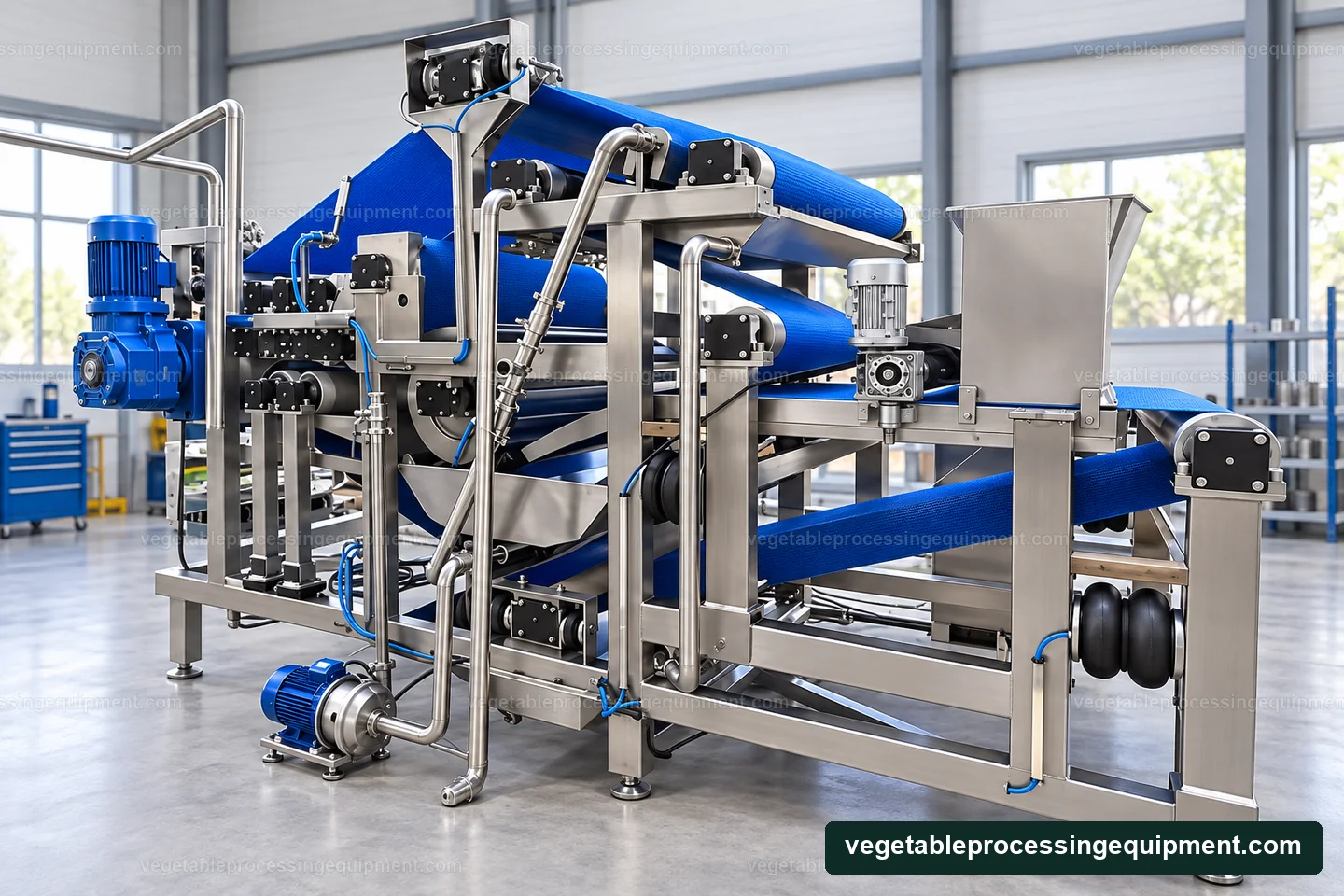
A belt press produces a liquid stream and a press cake. A pulper or finisher produces a screened pulp and a coarse reject stream. Collect each stream separately and weigh it. Sample each one for the properties that matter to the product: solids, texture, particle size, colour, temperature and any visible defects. Do not combine the streams into a single “waste” figure unless the process really combines them, because the product and co-product may have different values and different handling requirements.
The FAO chapter notes that press behaviour depends on feed condition, crush quality, pressure and time, and that over-pressing or extending the cycle can extract undesirable components as well as more liquid. This is why a trial should record the machine settings and the operator’s observations alongside the weights. A high yield obtained with excessive pressure or a very long cycle may not produce the quality the product specification requires. FAO juice processing principles
For a pulper, record the screen or screens used, the feed rate, the rotor or drive settings and the appearance of the reject. A change in screen size can alter both texture and throughput. If the trial uses more than one pass, keep the fractions from each pass separate until the team has decided how the product stream will be defined. The same discipline applies to any filtration, settling or centrifugation step: label the stream and record where it went.
Record additions, temperature and sample identity
Many vegetable products receive water, steam, recipe ingredients or processing aids during the trial. Record the quantity, composition and point of addition. Steam condensate is an addition too, and so is water used to flush or dilute a stream. Without this record, the output mass may appear larger or smaller than the material balance can explain. The same principle applies to any ingredient that is added before a sample is taken.
Temperature should be recorded at the points that affect the result: incoming material, preparation, extraction, any heating or holding step, and filling. Record the time as well as the reading. For a thermal process, the product temperature history and flow rate are part of the process definition, not incidental data. For an unheated trial, temperature still affects viscosity, drainage and microbial growth, so it belongs in the record.
Give every sample a unique identifier that links it to the lot, machine setting, stream and time. Store samples under conditions that preserve the properties being assessed, and record the storage time before analysis. A photograph is useful for appearance but cannot replace a measured texture, particle or solids result. If the trial team changes a setting partway through, start a new sample set rather than pooling results from different conditions.
Define the final product specification before judging the trial
The trial should be assessed against a product specification agreed in advance. For a juice, that may include appearance, clarity or cloud, particle content, taste and the intended thermal or preservation route. For a puree or sauce, it may include texture, screen residue, viscosity, particle size, colour and the behaviour of the product during pumping, heating and filling. A number for yield is meaningless if the product does not meet the specification that makes it saleable.
Record the basis for any yield statement: the mass and condition of the feed, the product stream included, the moisture or solids basis and the time over which the line ran. State whether the figure is a single-pass result or includes rework. Do not convert a trial result into a guaranteed production capacity. Scale, residence time, operator technique and raw-material variability can all change the outcome.
The most useful trial report ends with a mass balance table, a process log and a clear list of unresolved questions. It should say which streams were measured, which were estimated and which were not captured. That honesty makes the next trial better and gives the equipment supplier a defensible basis for a quotation. A trial is not a promise of shelf life or commercial sterility; it is evidence about the process step under the conditions tested. FAO technical manual
Primary guidance used
- FAO, Principles and practices of small- and medium-scale fruit juice processing, Chapter 6 Food and Agriculture Organization of the United Nations
- FAO, Technical manual on small-scale processing of fruits and vegetables (1997) Food and Agriculture Organization of the United Nations
External sources are linked for reference. Their publication does not constitute endorsement of this site or of any equipment configuration.